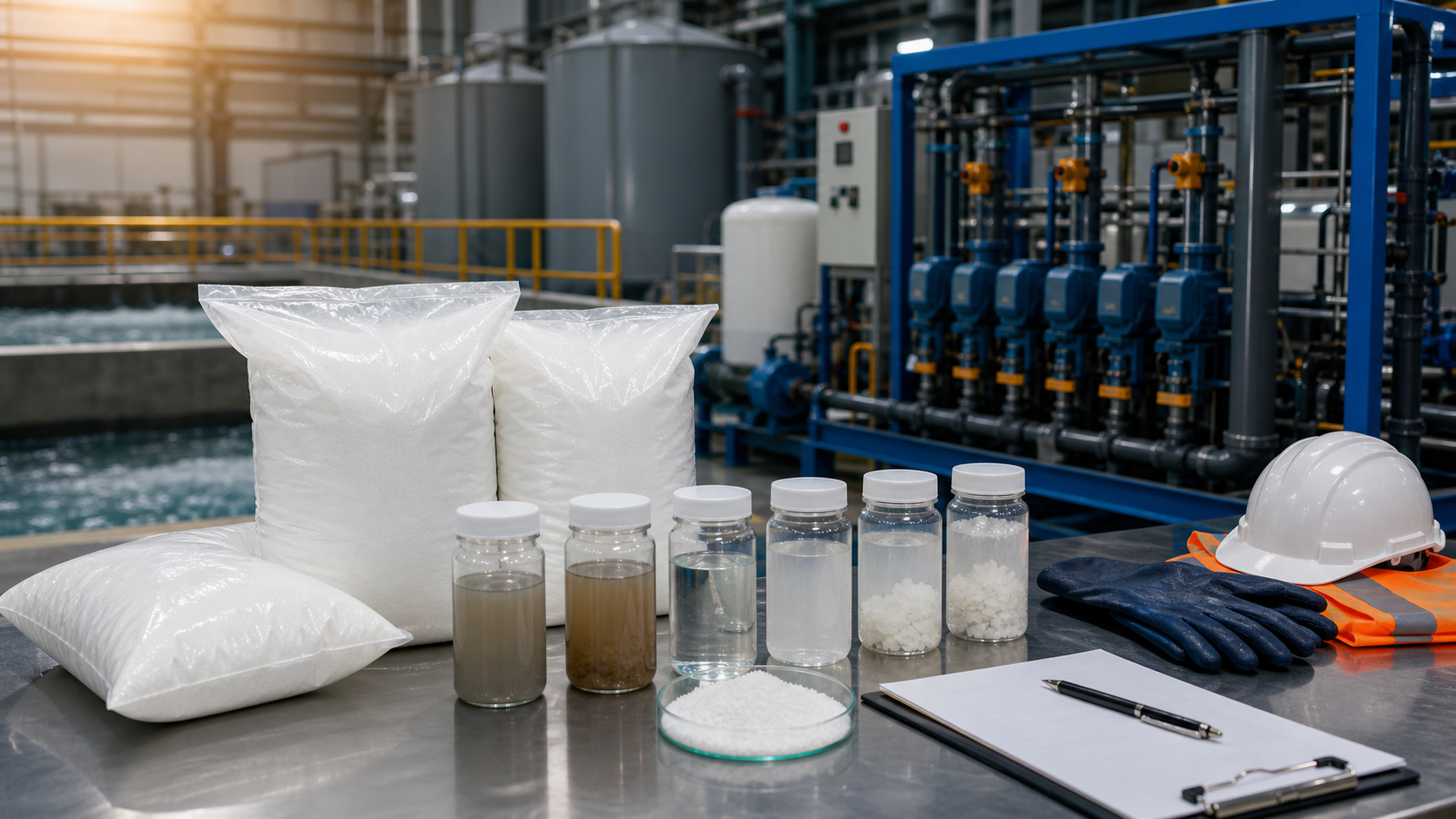
Low conductivity can be a useful description of process water, but it does not by itself specify a nonionic PAM grade. The mineral surface, solids concentration, pH and upstream treatment still affect the result. A sample purchase should establish whether a nonionic candidate solves the particular separation problem, not assume that low dissolved salt content makes it the only suitable polymer family.
Explain why a nonionic candidate is being considered
Tell the supplier what the current product fails to achieve. Examples include incomplete fine-particle capture, inconsistent floc formation or a narrow useful dose window. Provide observations from an untreated sample and the current treatment. Include conductivity with its units and measurement temperature where recorded, rather than describing the water merely as soft or clean.
Do not confuse a low-conductivity feed with a low-conductivity polymer preparation supply. They may be different waters. Identify both sources and any changes between seasons or operating shifts. A successful screening result made with laboratory water may not reproduce the way the plant prepares and transfers the solution.
Request a small, explainable screening set
Ask for the rationale behind each sample and keep its reference visible throughout preparation and testing. Where the supplier proposes an anionic comparison, retain it as a labelled alternative rather than treating the request as a competition between product names. The PAM selection guide explains why the treatment duty must remain the starting point.
Discuss the feed and make-down water with Xinqi Polymer's product team. Use the nonionic polymer information to frame questions about available candidates and preparation, then obtain instructions for the specific sample. A general catalogue page does not establish the hydration time or solution concentration for an individual grade.
Record more than the clearest beaker
Keep sample volume, mixing sequence, solution age and observation times consistent. Compare the untreated water, the current product and the proposed candidates over a documented range. Record overflow appearance or measured quality, settling behaviour and sediment volume. Note whether a floc remains manageable after the transfer conditions expected in the plant.
Avoid choosing a product from a single attractive photograph. If low conductivity varies during reuse or concentration cycles, test representative conditions separately. A candidate that performs well on fresh feed may need further work before approval for a system that progressively concentrates dissolved material.
Limit the first commercial commitment
Order a qualification quantity tied to the sample identity and the preparation instructions used. Record which conditions were tested and which were not. Require notification if the commercial grade or specification changes. This creates a defensible route from a promising nonionic sample to a controlled plant trial without presenting one bench result as evidence for every operating condition.