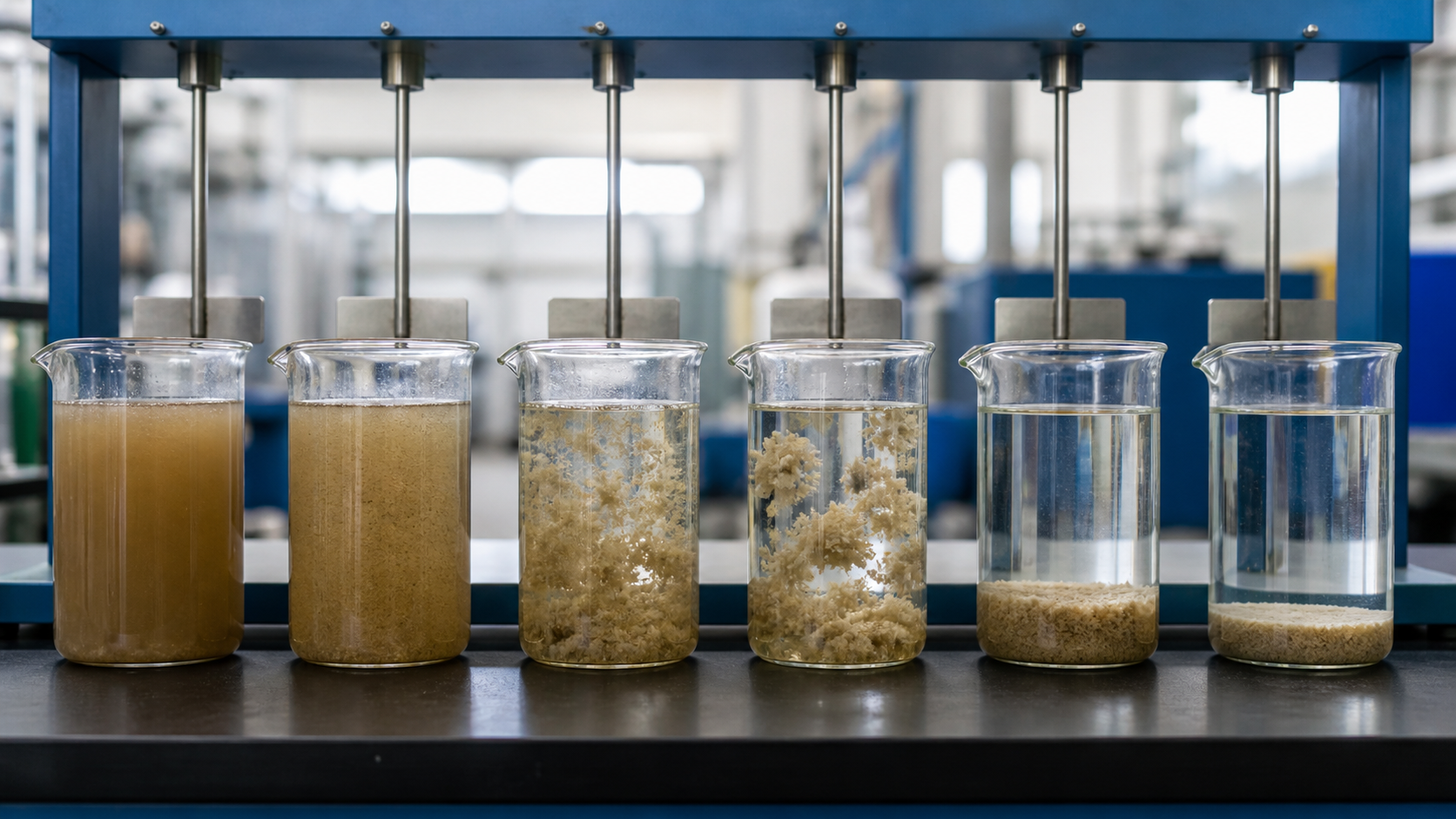
Ceramic polishing wastewater can contain fine mineral particles that remain suspended long after coarser material settles. A clarifier trial should therefore reproduce the particle mix and recycled-water conditions used by the polishing line. Selecting polymer from a sample of unusually clean return water can produce a system that works at idle load but fails during normal production.
Sample by production condition
Identify the polishing operations connected to the collection sump and record the product being processed. Keep samples from meaningfully different production conditions separate initially. A combined sample is useful only when its proportions represent the actual flow received by the clarifier. Note cleaning events and other additions that may alter the chemistry without changing the visible colour very much.
Measure feed suspended solids, pH and conductivity, then document the process-water temperature and reuse fraction. These data provide context for the trial rather than an automatic formula for polymer selection. If recycled water accumulates dissolved constituents, a successful test in fresh water may not predict the response after several operating cycles.
Compare clarity with sediment handling
Run an untreated control beside polymer candidates. Observe the rate at which the supernatant clears and how the settled bed changes with time. Some products may give rapid initial separation while producing bulky sediment that consumes storage volume. Others may settle more slowly but form a manageable underflow. The plant needs a balance that fits both its overflow demand and its solids-removal capacity.
The PAM sedimentation selection guide can help structure the supplier questions. Provide Xinqi Polymer with representative polishing slurry and the reuse constraints when requesting candidates. Information on mineral-water anionic polymers supports screening, but the mineral source alone does not select the charge density or molecular size.
Follow clarified water back to the polishing line
Agree which measurements matter at the reuse point. Depending on the equipment and product, these may include fine-particle carryover, nozzle reliability, filter loading or a documented finish-quality check. Let production quality staff define the acceptance criteria. Do not assume that lower turbidity guarantees a better finished surface, and do not invent a universal limit for all ceramic processes.
During a controlled trial, retain the normal separation and safety protections. Track the time when treated water enters reuse storage and when it reaches the production line. A quality observation made before that water arrives cannot establish compatibility. Retain a route for off-spec recovered water so the trial does not force an unapproved return to production.
Turn the result into a purchase specification
Specify the demonstrated operating range, preparation requirements, underflow behaviour and the production conditions tested. Include evidence of performance after recycle-water conditions stabilise. A supplier promise based only on a photograph of clear water is incomplete. The useful purchase outcome is repeatable clarification that supports the polishing process without creating an unmanageable sludge or downstream filter burden.