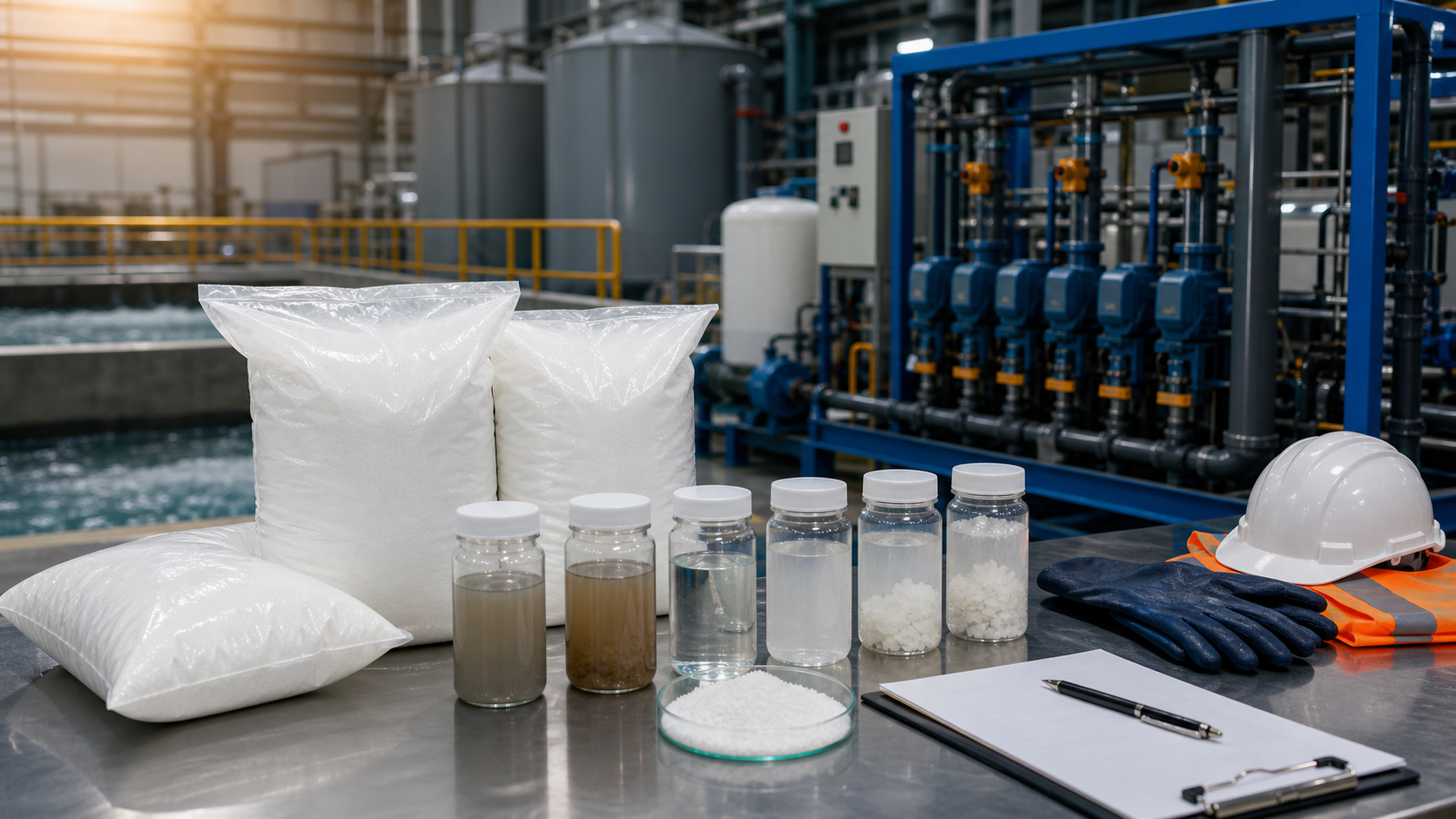
Buying PAM for a water-reuse clarifier requires two linked decisions: whether it separates the suspended solids and whether the clarified water remains suitable for the receiving process. Clear-looking overflow is not proof of reuse compatibility. Define the downstream constraints before a supplier sample is evaluated so a promising settling result does not conceal a production or filtration problem.
Identify where the recovered water goes
Map the route from clarifier overflow through storage, filters and the reuse connection. Record whether the water returns to washing, cooling or another industrial operation. Ask the responsible process owner which acceptance checks apply. Do not borrow a limit from an unrelated plant or assume that sedimentation removes dissolved salts, contaminants or microbiological risks.
Separate suspended-solids removal from other treatment duties. If the receiving process needs additional treatment, keep it in the operating plan during the polymer trial. The sedimentation-before-filtration guide explains why clarification and downstream barriers must be considered together.
Make the supplier aware of the reuse boundary
Tell the supplier about sensitive filters, spray nozzles, heat-transfer surfaces or product-quality constraints. Request the proposed product's data and safety documents, and ask which compatibility questions need further testing. Avoid requesting a generic assurance that a polymer is safe for every reuse application; the intended use and applicable requirements must be explicit.
Share the reuse flow diagram with Xinqi Polymer when discussing candidates. Information about the anionic product family can help shortlist options for mineral solids, but the candidate still has to pass the plant's separation and downstream checks.
Follow trial water through the complete circuit
Document when the trial water enters storage and when it reaches the receiving equipment. Compare measurements only after the relevant water has actually arrived. Keep production changes and filter maintenance in the log so their effects are not attributed automatically to a new polymer. Maintain the site's route for holding or diverting water that has not been approved for reuse.
Consider accumulation over repeated cycles. A short test on fresh water may not represent a circuit with a high reuse fraction. Record conductivity or other relevant indicators under normal operating conditions, and arrange further evaluation if the trial never reached the conditions used for the purchase decision.
Purchase against a defined operating envelope
Record the qualified feed range, preparation method, overflow checks and downstream observations. Specify that changes in the grade or formulation require review. A successful purchase should protect the complete water-reuse duty rather than reward the fastest initial settling alone. Where compatibility remains untested, state that limitation and keep the first order conditional on controlled plant confirmation.